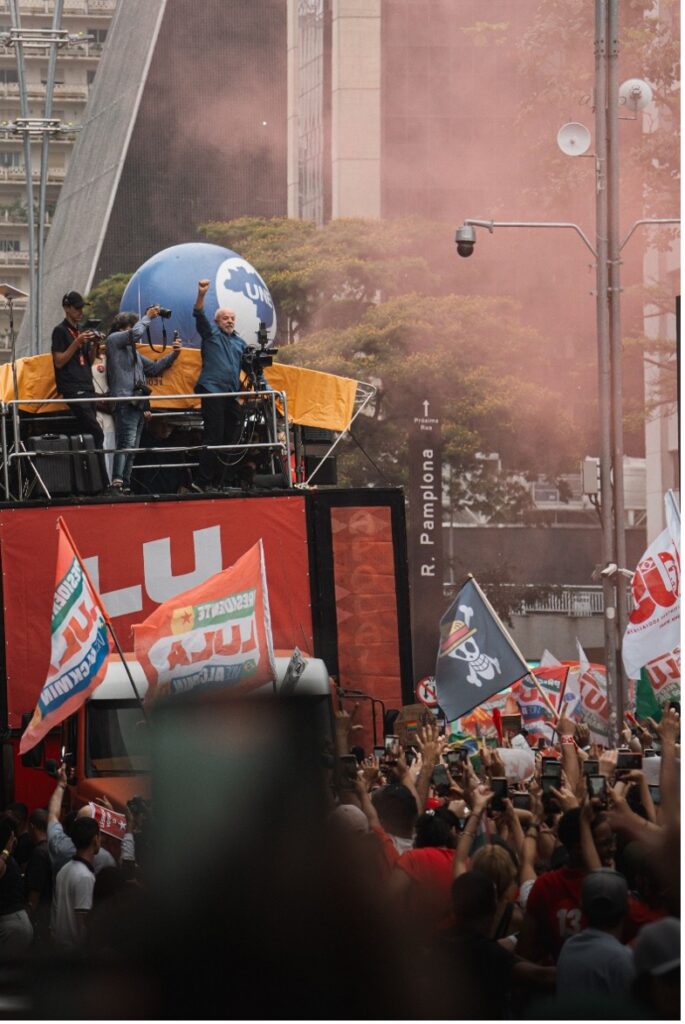
The climate surrounding the Brazilian presidential elections on Sunday, 25th of October 2026, was one of extreme polarisation.[1] With exit polls predicting a small margin and a ‘technical draw’ between far-right candidate and first-round-winner Flavio Bolsonaro and incumbent Brazilian president Luiz Inácio Lula da Silva, expectations were high for both sides. The tensions that animated voters, however, spoke to an election with more than policy divergences at stake, with commentators raising concerns about the consequences of a return of the Bolsonaro family to the Brazilian democratic order and the stability of Latin American politics broadly.
As voting began across the country, several concerns regarding the accessibility of voting booths were raised by both sides of the race. Heavy rains reportedly[2] made it difficult for voters in right-wing-leaning zones to complete their electoral duties. Some impediments, however, were not as natural. Despite federal orders for public transport to operate at full capacity to allow citizens to reach their designated voting spots, some local administrations reportedly restricted the operation of fleets that would normally connect socio-economically disadvantaged areas to their voting stations. Without the operation of public transport, voters were effectively impeded from exercising their political rights due to the geographical disadvantages that define the socio-economic inequalities in large Brazilian cities where wealth is concentrated in central and commercial areas.
Interference with the operation of bus fleets was but one impediment to an equal access to exercise a vote on election day. Indigenous communities – groups particularly threatened by the possible return to a Bolsonaro rule, a time marked by the deregulation and expansion of extractivist activities, deforestation and violence against indigenous peoples[3] – also found difficulties in reaching their allocated voting stations. Logistical complexities and resource complications affected[4] many indigenous communities located in more remote parts of the country, including those from the Javari valley in Amazonas, an area containing 74 indigenous peoples with more than 6 thousand individuals.
Dependence on resources for transportation to voting sites – as well as on the good faith of those who manage them – sheds light on the not-so-obvious socio-economic dimension of political rights. Human rights law theory has long wrestled with a division between socio-economic rights, which require significant public investment to be realised (i.e. the right to education, the right to housing, etc.), and civil and political rights, which are less resource-dependent by nature (i.e. the right to vote, freedom of expression, etc.).[5] Socio-economic inequalities and deprivation, however, expose the limitations of this conceptual division.
Socio-economic disadvantages generally demonstrate the tyrannical power of socio-economic exclusion and its reach to all facets of social and political life. Socio-economic deprivation does not only strike in the form of economic difficulties but hinders the exercise of social life generally. This is to say that, by invading all spheres of a social, political and economic life, poverty blurs normative qualifications of human rights by demonstrating an inherently economic dimension of social organisation than give strength to a simple proposition: socio-economic redistribution is inevitably a human rights law concern.
While the statement above shifts attention from the ‘nature’ of socio-economic or civil and political rights, it hints at another potentially useful dimension of human rights law, namely that of normative equality. Underlying international human rights law in its entirety is the prohibition of discrimination, which aims at negating group-based disadvantages that affect the access and exercise of rights and entitlements. But while such group-based focus has been criticised as limited, I argue it offers a promising lens for capturing the pervasive issue of socio-economic exclusion.
In the latest Brazilian elections, this exclusion stood at the heart of the debates between a progressive left and an austerity-driven right. But while casting their votes, Brazilians were once again faced with intersecting forms of discrimination that are often ignored. Targeted geographical and socio-economic discrimination showed how poverty can be weaponised for political interests, in this case by preventing those most interested in economic redistribution from casting their votes. In this context, the prohibition of discrimination must not be forgotten as a tool for capturing the real face of this form of exclusionary politics. A framework of socio-economic discrimination demonstrates, meanwhile, the inherently economic nature of all human rights and the dangers of targeted socio-economic exclusion for democracy.
But how does this framework look like concretely? As litigants pursue justice for the electoral irregularities committed in the latest elections, it is important to highlight the illegality of the weaponisation of poverty and of socio-economic exclusion from the electoral duty that falls within the scope of the right to vote in Brazil. Here, grounds of discrimination offer an important technical view into how equality is normatively safeguarded in international law. Discrimination is prohibited on the grounds of membership to social groups typically targeted by exclusionary practices, with the prohibited ground of poverty constituting a special case. This is because poverty describes a condition that not only makes an individual vulnerable to discriminatory practices and exclusion, but that itself constitutes a fundamental denial of participation in social life. The mere qualification of an individual within the ground of poverty, therefore, may itself constitute a discriminatory practice arising from the negligence or misconduct of the State regarding its obligations under the principle of equality and non-discrimination.[6] To be in a situation of poverty is to already be excluded from the basic guarantees that constitute the body of international human rights law. Such quality points to the particularly perverse nature of socio-economic exclusions.
This understanding can be empowering for an articulation of State obligations of guaranteeing human rights on an equal basis. However, how it is realised in the domestic context is a different matter. In the face of such targeted exclusion of the poor and the geographically disadvantaged from an election this crucial for the Brazilian structures of social welfare, a violation of the prohibition of discrimination is incontrovertible. How the State and those in local administrations will be made responsible is yet to be seen in that domestic context. Regardless of how this situation unfolds, it is an opportunity to shed light on Brazil’s and all States’ obligations regarding the principle of equality and non-discrimination and its potential in the scrutiny of socio-economic inequalities and poverty discrimination.
[1] Tom Phillips and Tiago Rogero, ‘Lula Wins Historic Fourth Term as Brazilian President in Defeat of Far-Right Flávio Bolsonaro’ The Guardian (26 October 2026) <https://www.theguardian.com/world/2026/oct/26/lula-wins-brazil-election> accessed 2 November 2026.
[2] Ione Wells and Hafsa Khalil, ‘Brazil Election: Lula Wins Fourth Term in Dramatic Comeback over Bolsonaro’ (26 October 2026) <https://www.bbc.com/news/articles/ckm23y3mg1yyo> accessed 2 November 2026.
[3] Tom Phillips, ‘“This Is a Lethal Threat”: Indigenous Groups Fear Bolsonaro’s Hold on Voters in Brazil’s Amazon Towns’ The Guardian (23 October 2026) <https://www.theguardian.com/world/2026/oct/23/brazil-indigenous-groups-fear-bolsonaro-voters-amazon-towns> accessed 2 November 2026.
[4] ‘Juíza do AM nega transporte e comida para indígenas votarem’ Migalhas (21 October 2026) <https://www.migalhas.com.br/quentes/466956/juiza-do-am-nega-transporte-e-comida-para-indigenas-votarem> accessed 2 November 2026.
[5] Olivier De Schutter, ‘Introduction’ in Olivier De Schutter (ed), Economic, Social and Cultural Rights as Human Rights (Edward Elgar 2013).
[6] See, for instance, Case of the workers of the fireworks factory in Santo Antônio de Jesus and their families v Brazil (Inter-American Court of Human Rights) [186–187].